
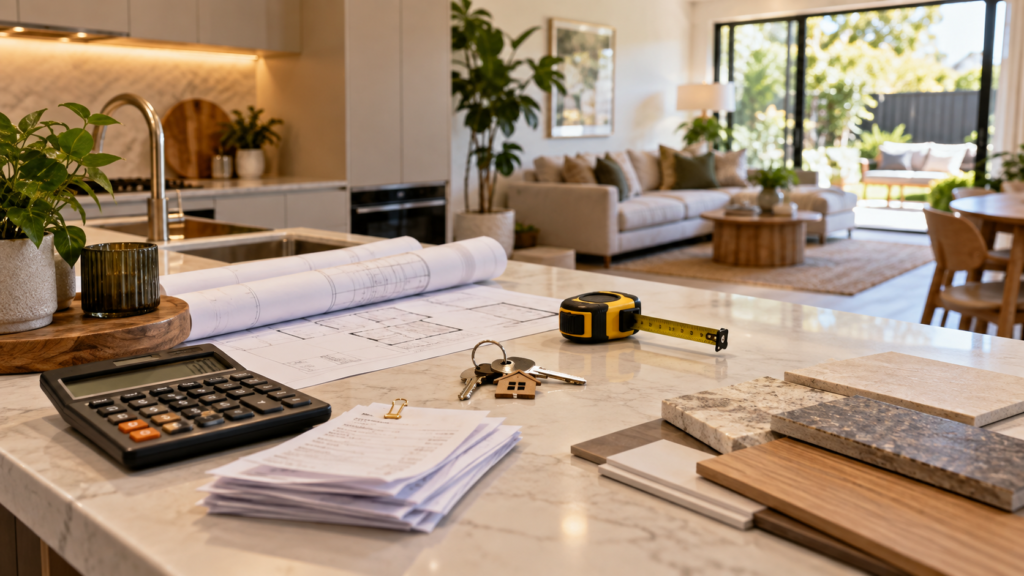
Renovating an investment property feels like a high-stakes balancing act. Landlords spend serious cash to attract premium tenants and push up rental yields. The real financial victory happens months later at tax time. The Australian Taxation Office (ATO) enforces strict rules around property expenses. Muck them up, and those lucrative tax perks vanish entirely.
The Ultimate Tax Trap Repairs Versus Capital Improvements
Property owners constantly confuse a basic repair with a capital improvement. This single mistake costs investors thousands every year. A repair simply restores an item to its original state. Think fixing a smashed window, mending a leaking pipe, or replacing a few cracked roof tiles. The ATO lets investors claim these costs immediately in the current financial year.
Capital improvements go significantly further. They enhance the property beyond its original condition or function. Installing a brand new split-system air conditioner where there was none? That’s an improvement. In competitive Sydney suburban rental markets where street appeal commands top-tier weekly yields, the same logic applies to engaging driveway concreters Sydney to replace a cracked dirt entrance with a sleek exposed aggregate driveway. You can’t claim these massive costs in one hit. Instead, they depreciate slowly over several years. Knowing this distinction stops nasty surprises during a tax audit.
Maximise Depreciation with Division 40 and Division 43
Savvy investors squeeze every drop out of property depreciation. The ATO splits these claims into two distinct buckets.
First is Plant and Equipment, known as Division 40. These are the easily removable mechanical items. Curtains, dishwashers, carpets, hot water systems, and blinds fall right here. They depreciate faster because they wear out quicker.
Then comes Capital Works, or Division 43. This covers the heavy structural stuff. Walls, roofs, and permanent built-in cabinetry. These depreciate at a slow and steady 2.5 per cent over 40 years. Treat these property upgrades seriously. Have a certified quantity surveyor draw up a proper depreciation schedule before the first hammer swings. Investors who skip this crucial step leave an average of $4,000 to $9,000 on the table in their first full financial year alone.
The Hidden Power of Scrapping
Ever heard of scrapping? Most everyday landlords miss this strategy entirely. When tearing out old assets during a renovation, those discarded items often hold residual value on paper.
Imagine gutting a ten-year-old bathroom. The old vanity, toilet, and exhaust fan might still have unclaimed depreciation value. If they get thrown straight into a skip bin without documentation, that value is lost forever. But if properly recorded, that residual value becomes an instant tax deduction in the current financial year. A standard bathroom demolition can sometimes yield $2,500 in instant write-offs.
There’s a catch. A quantity surveyor must value the old items before demolition starts. Take photos. Document everything. Once the tradies smash it to pieces, the evidence is gone.
Beware the Initial Repair Rule
Buying a tired house and renovating it before renting it out seems smart. It makes sense on paper to fix the place up to command higher rent. The ATO views things differently.
If a landlord fixes defects that existed at the time of purchase, those costs are classed as initial repairs. You can’t claim them as an immediate deduction. The ATO considers these expenses part of the property’s acquisition cost. They simply add to the capital cost base. This only helps reduce Capital Gains Tax when the property is eventually sold decades down the track.
Want the immediate deduction? The property must be rented out, or genuinely available for rent, before the damage occurs. Wait a year. Let the property generate income. Then bring in the builders to fix the genuine wear and tear.
Don’t Forget Borrowing Expenses
Major renovations often require serious capital. Landlords frequently refinance or take out a new specific loan to fund the project. Those borrowing expenses are entirely deductible. Loan establishment fees, title search fees, valuation costs, and mortgage broker fees all count.
These expenses are claimed over five years or the life of the loan, whichever is shorter. If the total borrowing costs are under $100, they are claimed entirely in the first year. This is a quiet little deduction. People focus so heavily on the shiny new kitchen that they forget to claim the paperwork that paid for it.

Apportioning Costs for Partial Rentals
Not every investment property is a standalone house. Sometimes landlords rent out a granny flat in the backyard or a single room. When renovations affect shared areas, claiming deductions gets complicated.
If you fix a roof that covers both your primary residence and the rented granny flat, you can’t claim the whole bill. The ATO requires landlords to apportion the expense. This is usually calculated based on floor area. If the rented space makes up 30 per cent of the total building footprint, you can only claim 30 per cent of the repair cost. Get this calculation wrong, and the ATO will issue an amended assessment with interest applied.
Keep Impeccable Records
Good intentions never survive an ATO audit. Receipts do.
Relying on bank statements is a fast track to rejected claims. Bank statements only show a transaction occurred. They don’t prove what the money actually bought. A $5,000 charge from Bunnings could be for a deductible investment property repair. It could also be for a new BBQ for your own backyard. The ATO knows this.
Store physical receipts carefully or use cloud software to digitise them instantly on site. Keep a clear logbook. Travel expenses to inspect residential investment properties are no longer deductible. But clear records of the actual material and labour costs remain absolutely essential. Every lost receipt is a lost tax deduction.